

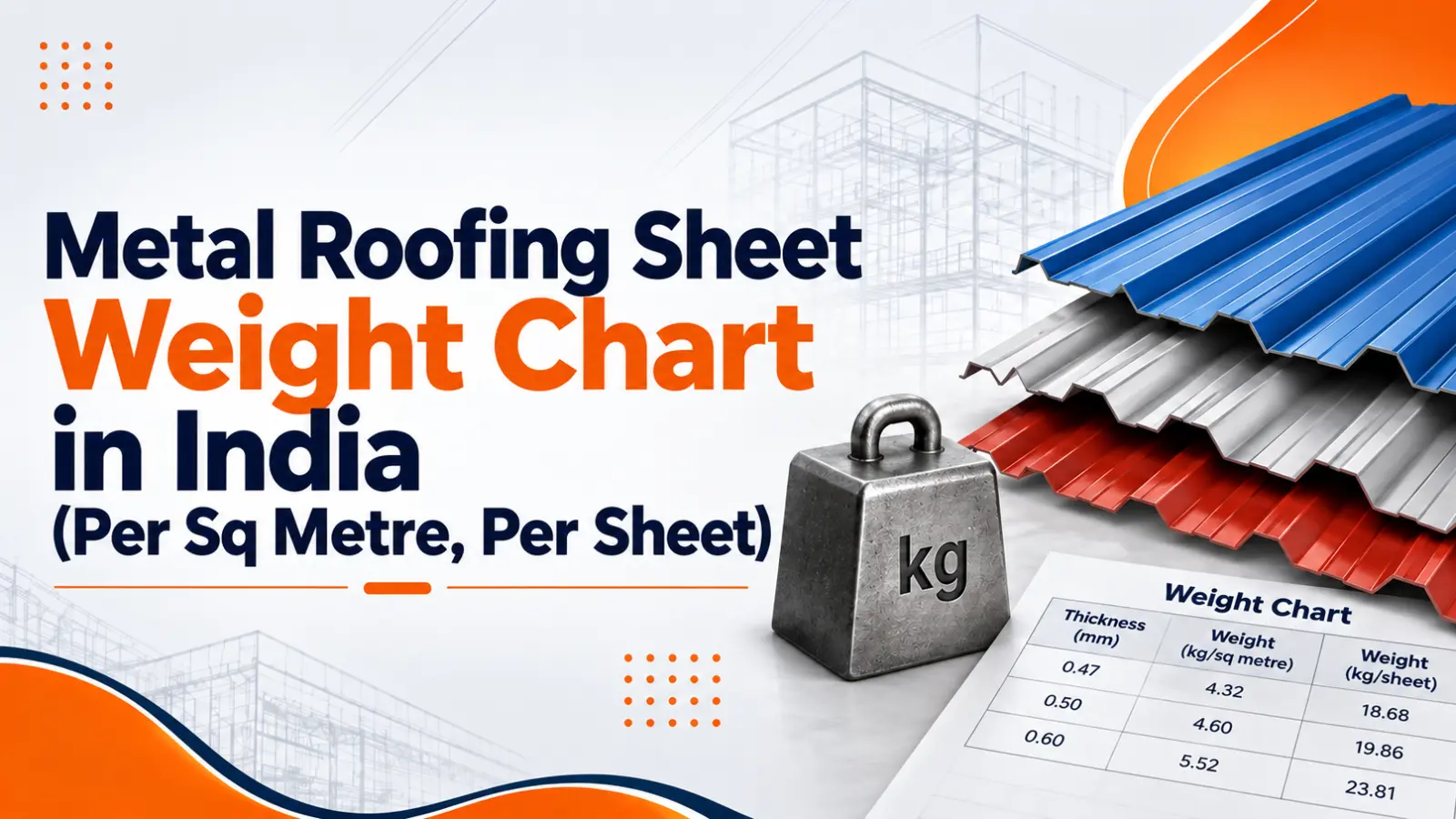
Metal roofing sheets are widely used in residential buildings, warehouses, factories, commercial properties and agricultural structures across India. While choosing a roofing sheet, thickness, coating, profile and dimensions are usually given the most attention. However, the weight of metal roofing sheets is equally important.
The weight of a roofing sheet affects transportation, handling, installation and the load placed on the supporting structure. A clear metal roofing sheet weight chart can therefore help builders, contractors and homeowners estimate material requirements and plan their projects more accurately.
In India, commonly used metal roofing sheets are available in thicknesses of 0.30 mm, 0.35 mm, 0.40 mm, 0.47 mm, 0.50 mm, and 0.60 mm.
The weight increases with thickness. However, the actual weight can also vary based on the sheet profile, coating and dimensions.
What Determines the Weight of a Metal Roofing Sheet?
The weight of a metal roofing sheet mainly depends on four factors: thickness, length, width and material density.
Thickness has the most direct impact. A thicker sheet contains more metal per square metre and, therefore, weighs more. For example, a 0.50 mm sheet will generally weigh more than a 0.35 mm sheet of the same dimensions.
The basic calculation for a flat steel sheet is:
Weight = Length × Width × Thickness × Density
For steel, a density of around 7,850 kg/m³ is commonly used for weight calculations.
This means that a 1 m² steel sheet with a thickness of 1 mm weighs approximately 7.85 kg before accounting for coatings and other factors.
Roofing sheets are not usually flat plates. They are profiled into corrugated or trapezoidal shapes. As a result, the actual weight of a finished roofing sheet can differ from a simple flat-sheet calculation.
Metal Roofing Sheet Weight Chart Per Square Metre
The following metal roofing sheet weight chart provides indicative weights for commonly used thicknesses in India.
Sheet Thickness: Approx. Weight per Sq Metre
- 0.30 mm: 2.8–3.2 kg
- 0.35 mm: 3.3–3.6 kg
- 0.40 mm: 3.7–4.1 kg
- 0.45 mm: 4.4–4.7 kg
- 0.50 mm: 4.8–5.1 kg
These figures should be treated as practical estimates rather than fixed values. The final weight may vary depending on the steel grade, coating, profile design and manufacturing tolerances.
For comparison, the theoretical weight of bare steel at 7850 kg/m³ is approximately 2.36 kg/m² at 0.30 mm and 3.93 kg/m² at 0.50 mm. Galvanising or other coatings can add to the overall mass.
Therefore, when comparing roofing sheet weight per square metre, it is important to check whether the quoted figure refers to bare steel, coated material or the finished profiled sheet.
Metal Roofing Sheet Weight Per Sheet
Knowing the weight per square metre is useful, but many buyers need to know the weight of each sheet. This depends on the sheet’s length and width.
For example, an 8 ft × 3 ft sheet covers approximately 2.23 square metres. If the finished sheet weighs around 3.6 kg per square metre, its approximate weight would be: 2.23 × 3.6 = 8.03 kg per sheet
This gives an approximate weight of 8 kg per sheet.
Using the same approach, a sheet weighing 5 kg per square metre would weigh approximately: 2.23 × 5 = 11.15 kg per sheet.
Therefore, even when two roofing sheets have the same width and length, a difference in thickness can significantly change their weight.
Actual manufacturer specifications should always be checked for procurement and structural calculations. For example, published weight calculations for galvanised sheets show that weight increases directly with both thickness and sheet length.
Metal Roofing Sheet Weight Chart for Different Thicknesses
Thickness is one of the easiest ways to compare roofing sheet weights. Here is a simple overview:
0.30 mm Roofing Sheet
A 0.30 mm roofing sheet is among the lighter options. Its approximate finished weight is around 2.8 to 3.2 kg per square metre.
These sheets may be suitable for applications where low weight and cost are important. However, the selection should consider the expected weather conditions, span, support spacing and intended use.
0.35 mm Roofing Sheet
At around 3.3-3.6 kg per square metre, a 0.35 mm sheet offers a modest increase in material thickness.
It is often considered when a project needs a balance between weight, cost and basic durability.
0.40 mm Roofing Sheet
A 0.40 mm sheet generally weighs around 3.7 to 4.1 kg per square metre.
The additional thickness provides greater material mass compared with thinner sheets. It can be considered for residential, commercial, and light-industrial roofing, depending on the design requirements.
0.47 mm Roofing Sheet
With an approximate weight of 4.5-4.7 kg per square metre, 0.47 mm roofing sheets are heavier than the commonly used thinner options.
Perfect for industrial sheds, warehouses, factories and large commercial buildings.
0.50 mm Roofing Sheet
A 0.50 mm roofing sheet can weigh approximately 4.8-5.1 kg per square metre.
Because more steel is used, these sheets are generally heavier and can provide a more robust roofing solution. The additional weight, however, should be considered when designing the supporting framework.
How to Calculate Roofing Sheet Weight?
Calculating the approximate weight of a roofing sheet is straightforward.
First, determine the sheet’s area:
Area = Length × Width
Next, multiply the area by the weight per square metre:
Weight per sheet = Sheet area × weight per square metre
For example, consider an 8-ft × 3-ft sheet.
8 ft = 2.438 metres
3 ft = 0.914 metres
Therefore:
Area = 2.438 × 0.914 = approximately 2.23 m²
If the roofing material weighs 4.5 kg per square metre:
2.23 × 4.5 = approximately 10.04 kg
So, the sheet would weigh roughly 10 kg.
This calculation is useful for estimating the total material weight for transportation and handling. For large projects, however, the manufacturer’s declared weight should be used for final calculations.
Why Is Roofing Sheet Weight Important?
Understanding the weight of metal roofing sheets is useful at several stages of a construction project.
- Structural planning: The roofing material contributes to the roof’s dead load. Heavier sheets may require suitable supporting members and spacing.
- Transportation: The total weight of roofing sheets affects vehicle loading and transportation planning.
- Installation: Lighter sheets are generally easier for workers to lift and handle, particularly on larger or elevated structures.
- Material estimation: Weight calculations can help contractors estimate the quantity and total mass of material required.
- Cost planning: Some metal roofing products are priced by weight, while others are priced by area or sheet. Knowing the approximate weight helps with better cost comparisons.
Does Roofing Sheet Profile Affect Its Weight?
Yes. Roofing sheets are available in various profiles, such as corrugated and trapezoidal. The profile changes the actual amount of material used across the sheet.
Another important point is the difference between overall width and effective cover width. The overall width is the physical width of the sheet, while the effective cover width accounts for the overlap between adjacent sheets.
This matters when calculating how many sheets are needed for a roof. A published example for galvanised corrugated sheets, for instance, uses an effective cover width rather than simply treating the entire overall width as usable roofing coverage.
Therefore, always check the manufacturer’s effective cover width before estimating the total number of sheets.
How Coating Affects Metal Roofing Sheet Weight?
Metal roofing sheets may have protective coatings such as zinc or aluminium-zinc, while pre-painted sheets also have primer and paint layers.
These coatings add a relatively small amount of weight to the finished product. For example, galvanised sheet calculations may include the zinc coating separately from the base steel weight.
This is why two sheets with the same nominal thickness may not have the same weight.
For an accurate per-sheet roofing sheet weight calculation, it is better to refer to the product’s technical specifications rather than relying solely on nominal thickness.
Choosing the Right Roofing Sheet Thickness
The heaviest sheet is not automatically the best choice for every project. Similarly, choosing the lightest sheet only to reduce cost may not always be suitable.
The right thickness depends on factors such as the building type, roof span, purlin spacing, local weather conditions, expected loads, installation requirements and budget.
For a residential structure, a different specification may be suitable compared with a large industrial warehouse. Coastal and high-wind areas may also require additional consideration.
Therefore, thickness should be selected based on the overall roofing design rather than weight alone.
Final Thoughts
A metal roofing sheet weight chart provides a useful starting point when comparing roofing materials in India. The weight per sheet then depends on its actual dimensions and effective coverage. Thickness, profile, coating and manufacturing specifications can all cause variations.
For accurate procurement, transportation planning and structural design, always check the manufacturer’s technical data along with the nominal thickness.
A proper understanding of roofing sheet weight per square metre and per sheet can help make the selection process more practical, economical and reliable.
Need exact specifications for your project? Get factory-direct metal roofing sheets from Topaaz Industries, manufactured in Guduvancherry, Chennai.