

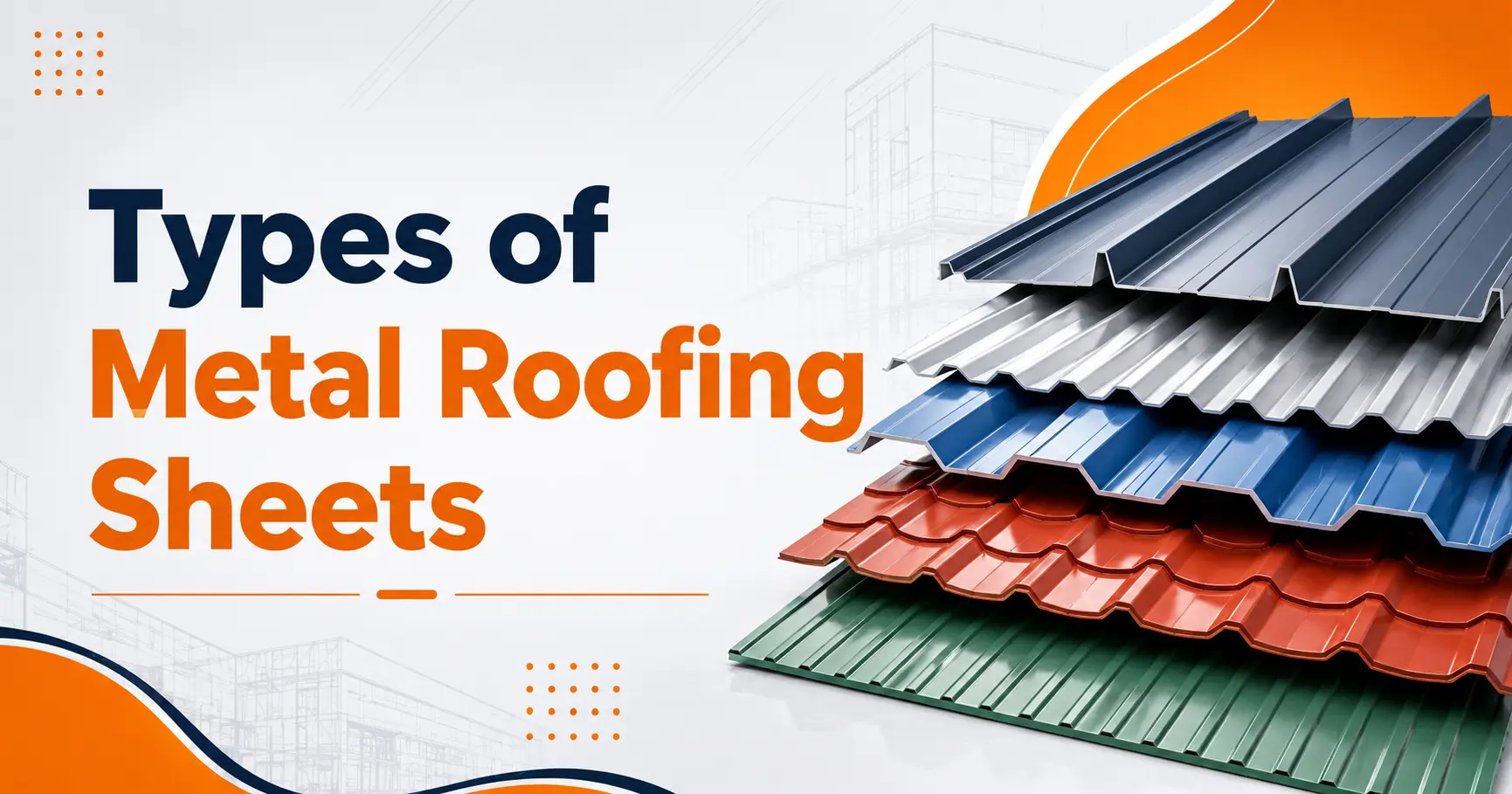
Metal roofing has become one of the most preferred roofing solutions for residential, commercial, agricultural, and industrial buildings. Its strength, durability, low maintenance, and modern appearance make it a practical choice for India’s diverse climate.
However, choosing the right roofing material can be challenging because there are several types of metal roofing sheets available, each designed for different applications and performance requirements.
Understanding the Types of Metal Roofing Sheets helps property owners select the ideal roofing solution based on budget, weather conditions, structural needs, and aesthetics. From traditional galvanised sheets to premium standing seam roofing, every type offers unique advantages that suit specific projects.
In this guide, we will explore the most popular Types of metal roofing sheets, explain how they differ, and discuss their benefits to help you make an informed decision.
GI (Galvanised Iron) Corrugated Sheets
GI (Galvanised Iron) Corrugated Sheets are among the oldest and most widely used types of metal roofing sheets in India. These sheets are manufactured using high-quality steel coated with a protective layer of zinc through the galvanisation process.
The zinc coating acts as a shield that protects the steel from rust and corrosion, making the sheets suitable for long-term outdoor use.
The corrugated profile enhances the sheet’s structural strength while keeping it lightweight. The wave-like design allows the sheets to withstand heavy rainfall, wind loads, and moderate impact without bending easily. Because of their affordability and durability, GI corrugated sheets are commonly installed in warehouses, factories, poultry farms, sheds, workshops, garages, and rural housing.
These roofing sheets are also easy to transport, install, and replace, making them a preferred option for projects requiring quick construction. Regular maintenance further increases their lifespan, allowing them to perform efficiently for many years.
Among the many types of metal roofing sheets, GI corrugated sheets remain one of the most economical choices for large-scale roofing projects.
Common Dimensions / Specifications: Thickness: 0.30 mm–0.80 mm; Effective Width: 762 mm–900 mm; Length: 1 m–12 m (customisable); Zinc Coating: 120–275 GSM
Advantages of GI Corrugated Sheets
- Excellent resistance to rust due to zinc coating.
- Cost-effective roofing solution for industrial and agricultural buildings.
- Lightweight design ensures faster installation and reduced structural load.
PPGI (Pre-Painted Galvanised) Sheets
PPGI (Pre-Painted Galvanised Iron) Sheets are modern roofing materials manufactured by applying multiple protective paint coatings over galvanised steel. The paint layer not only improves appearance but also adds an extra barrier against moisture, UV rays, and environmental pollutants.
These sheets are available in a wide range of colours and finishes, allowing architects and builders to match different building styles. Their attractive appearance makes them suitable for commercial buildings, shopping complexes, educational institutions, residential homes, and industrial structures.
Apart from aesthetics, PPGI sheets offer reliable performance under varying weather conditions. The paint coating helps minimise fading and peeling while reducing maintenance requirements. These sheets also provide good thermal reflection, which helps lower indoor temperatures during hot summers.
Among the various types of metal roofing sheets, PPGI sheets are often selected when both durability and visual appeal are equally important. Their combination of corrosion protection, colour retention, and structural strength makes them a popular roofing solution across India.
Common Dimensions / Specifications: Thickness: 0.30 mm–0.60 mm; Width: 1000 mm–1220 mm; Length: Up to 12 m; Paint Coating: 20–25 microns (top), 5–7 microns (back)
Advantages of PPGI Sheets
- Attractive colour options enhance building appearance.
- Additional paint coating improves corrosion resistance.
- Low maintenance with excellent colour retention over time.
PPGL (Pre-Painted Galvalume) Sheets
PPGL (Pre-Painted Galvalume) Sheets are manufactured using Galvalume steel coated with aluminium, zinc, and silicon, followed by a premium paint finish. This combination provides exceptional protection against corrosion while delivering a clean and modern appearance.
PPGL sheets perform exceptionally well in coastal regions and areas with high humidity where conventional galvanised sheets may deteriorate more quickly. The aluminium-rich coating reflects heat effectively, helping improve energy efficiency inside buildings.
These roofing sheets are widely used in factories, commercial complexes, airports, warehouses, industrial sheds, and premium residential projects. Their long service life and resistance to environmental damage make them one of the most advanced types of metal roofing sheets available today.
In addition to superior corrosion resistance, PPGL sheets maintain their colour and finish for many years, reducing repainting costs and improving overall building aesthetics.
Common Dimensions / Specifications: Thickness: 0.30 mm–0.60 mm; Width: 914 mm, 1000 mm, 1220 mm; AZ Coating: AZ70–AZ150; Length: Up to 12 m
Advantages of PPGL Sheets
- Outstanding corrosion resistance in harsh environments.
- Better heat reflection improves indoor comfort.
- Longer lifespan with excellent paint durability.
Bare Galvalume (BGL) Sheets
Bare Galvalume (BGL) Sheets are manufactured without any coloured paint coating. Instead, they feature a metallic finish created by an aluminium-zinc alloy coating that provides excellent corrosion protection.
The aluminium component protects the surface from oxidation, while zinc offers sacrificial protection whenever scratches occur. This unique combination makes BGL sheets highly durable even in challenging weather conditions.
These sheets are commonly used for industrial roofing, warehouses, storage facilities, manufacturing plants, and infrastructure projects where functionality is prioritised over decorative appearance.
Among all types of metal roofing sheets, Bare Galvalume sheets are recognised for their outstanding durability and long service life with minimal maintenance. Their natural metallic appearance also gives industrial buildings a clean and professional look.
Common Dimensions / Specifications: Thickness: 0.35 mm–0.80 mm; Width: 914 mm–1220 mm; Aluminium-Zinc Coating: 55% Al, 43.4% Zn, 1.6% Si
Advantages of Bare Galvalume (BGL) Sheets
- Superior resistance to corrosion and oxidation.
- Long-lasting performance with minimal maintenance.
- Ideal for industrial and commercial roofing applications.
Colour-Coated Trapezoidal Profile Sheets
Colour-Coated Trapezoidal Profile Sheets are engineered with a trapezoidal rib design that provides exceptional load-bearing capacity. The profile increases structural rigidity while maintaining a lightweight construction.
These sheets are manufactured using galvanised or Galvalume steel coated with weather-resistant paint. They are available in multiple colours and thicknesses, making them suitable for industrial buildings, warehouses, shopping centres, factories, and commercial complexes.
The trapezoidal profile allows rainwater to drain efficiently while improving roof strength against heavy winds and rainfall. Their modern appearance also enhances the overall architectural appeal of buildings.
Among the many types of metal roofing sheets, trapezoidal profile sheets are valued for their combination of structural strength, aesthetics, and long-term durability.
Common Dimensions / Specifications: Thickness: 0.35 mm–0.60 mm; Rib Height: 25–35 mm; Effective Width: 1000 mm; Length: Up to 12 m
Advantages of Colour-Coated Trapezoidal Profile Sheets
- High structural strength for large-span buildings.
- Efficient water drainage during heavy rainfall.
- Modern appearance with multiple colour choices.
Standing Seam Metal Roofing
Standing seam metal roofing represents one of the most premium types of metal roofing sheets available today. Unlike conventional roofing systems that use exposed fasteners, standing seam roofs feature concealed fixing systems with raised vertical seams connecting adjacent panels.
This design significantly reduces the chances of water leakage because fasteners remain protected beneath the panels. The roofing system also allows thermal expansion and contraction without causing damage to the panels.
Standing seam roofing is widely used in premium homes, commercial offices, airports, educational institutions, and modern architectural projects where both aesthetics and long-term performance are important.
Although the initial investment is higher, the roofing system offers exceptional durability, weather resistance, and minimal maintenance, making it a worthwhile long-term investment.
Common Dimensions / Specifications: Panel Width: 300–500 mm; Seam Height: 25–65 mm; Thickness: 0.45 mm–0.70 mm; Length: Custom-made up to 30 m
Advantages of Standing Seam Metal Roofing
- Concealed fasteners minimize leakage risks.
- Excellent performance under extreme weather conditions.
- Premium appearance with long service life.
Corrosion-Resistant Steel Roofing
Corrosion-Resistant Steel Roofing is specially designed for locations exposed to moisture, chemicals, salt-laden air, or industrial pollutants. Advanced protective coatings significantly improve resistance to rust and environmental damage.
These roofing systems are commonly installed in coastal regions, chemical plants, ports, food processing units, pharmaceutical industries, and manufacturing facilities where corrosion poses a major concern.
The specialised coatings reduce maintenance costs while extending the overall lifespan of the roof. Even under challenging environmental conditions, corrosion-resistant roofing maintains its structural integrity for many years.
When comparing different types of metal roofing sheets, corrosion-resistant steel roofing is among the best choices for demanding industrial applications.
Common Dimensions / Specifications: Thickness: 0.40 mm–0.80 mm; Zinc/Aluminium Coating: 150–275 GSM; Width: 1000 mm–1220 mm
Advantages of Corrosion-Resistant Steel Roofing
- Performs well in coastal and industrial environments.
- Reduces maintenance and replacement costs.
- Extended lifespan under harsh weather conditions.
Stone-Coated Steel Roofing
Stone-Coated Steel Roofing combines the strength of steel with the visual appeal of traditional roofing materials such as tiles or shingles. The steel base is protected with multiple coatings before being covered with natural stone granules.
These granules improve aesthetics while providing additional protection against UV rays, impact, and weathering. Stone-coated roofing is increasingly used for luxury villas, resorts, hotels, premium residential projects, and institutional buildings.
Besides its attractive appearance, this roofing system is lightweight compared to conventional concrete or clay tiles. The reduced weight places less stress on the building structure while maintaining excellent durability.
Among premium types of metal roofing Sheets, stone-coated steel roofing delivers an excellent balance of beauty, strength, and longevity.
Common Dimensions / Specifications: Tile Size: Approximately 1340 × 420 mm; Effective Coverage: ~0.45–0.50 m² per tile; Steel Thickness: 0.35–0.45 mm
Advantages of Stone-Coated Steel Roofing
- Elegant appearance resembling traditional roof tiles.
- Lightweight yet highly durable construction.
- Excellent resistance to weather, UV rays, and impact.
Metal Shingle Roofing
Metal shingle roofing offers the classic appearance of conventional shingles while delivering the durability and longevity of steel. These roofing systems are manufactured in various profiles that imitate slate, wood, or traditional roofing shingles.
Metal shingles are suitable for residential homes, heritage-style buildings, villas, cottages, and commercial properties seeking premium aesthetics without compromising structural performance.
These roofing systems resist cracking, warping, insect damage, and moisture-related issues commonly associated with traditional roofing materials. Their lightweight construction also simplifies installation while reducing structural load.
Among modern Types of Metal Roofing Sheets, metal shingles provide homeowners with an attractive roofing solution that combines beauty, durability, and low maintenance.
Common Dimensions / Specifications: Panel Size: Approximately 1300 × 370 mm; Thickness: 0.40–0.50 mm; Weight: Around 2.5–3.5 kg per panel
Advantages of Metal Shingle Roofing
- Traditional appearance with modern steel durability.
- Lightweight and easy to install.
- Excellent resistance to weather and long-term wear.
Conclusion
Selecting the right types of metal roofing sheets depends on your building’s purpose, environmental conditions, design preferences, and budget. While GI corrugated sheets offer affordability for industrial projects, PPGI and PPGL sheets provide enhanced aesthetics and superior corrosion resistance. Bare Galvalume sheets excel in industrial environments, whereas trapezoidal profile sheets deliver structural strength for large buildings.
Standing seam roofing offers premium leak protection, corrosion-resistant steel roofing performs exceptionally in harsh climates, and stone-coated steel and metal shingles combine durability with elegant architectural appeal.